How to choose the right tap
- Sean Chen
- Mar 26, 2019
- 4 min read

Threads are a common method of joining mechanical parts, and taps are a common tool for machining internal threads. Correctly select the tap to machine the internal thread, you can
Ensure the quality of the threaded connection and increase the service life of the tap.
Select tap tolerance zone Domestic machine taps are marked with medium diameter tolerance band code: H1, H2, H3 respectively indicate different positions of the tolerance band, but the tolerance values are equal. Hand wire
The tolerance of the cone is coded as H4. The tolerance value, pitch and angle error are larger than the machine tap. The material, heat treatment and production process are not as good as the machine tap.
H4 may not be marked as required. The internal thread tolerance band grades that can be machined by the tap diameter tolerance band are as follows:
Tap tolerance band code for internal thread tolerance band H1 4H, 5H H2 5G, 6H H3 6G, 7H, 7G H4 6H, 7H
Some companies use imported taps, and German manufacturers often mark ISO1 4H, ISO2 6H, ISO3 6G (international standard ISO1-3 and national standard H1-
3 is equivalent), so that the tap tolerance band code and the machined internal thread tolerance band are marked. Metal processing WeChat, good content, worth it
attention.
Select the thread system At present, there are three common types of common threads: metric, imperial, and unified (also known as the US). Metric is a snail with a tooth angle of 60 degrees in millimeters
Pattern. Metal processing WeChat, the content is good, it is worthy of attention. For example: M8X1-6H means metric fine thread with a diameter of 8 mm, pitch 1 mm, 6H
Internal thread tolerance band.
Inch is a thread with a tooth angle of 55 degrees in inches. For example: BSW 1/4-20 means 1/4 inch in diameter and coarse pitch is 20 teeth per inch.
Threads are currently rarely used.
Another uniform system is a thread with a tooth angle of 60 degrees in inches. Diameter less than 1/4 inch, commonly used number, represented by 0 to 12 respectively
Diameter size from 0.06" to 1/4". The main use in the United States is still the uniform thread.
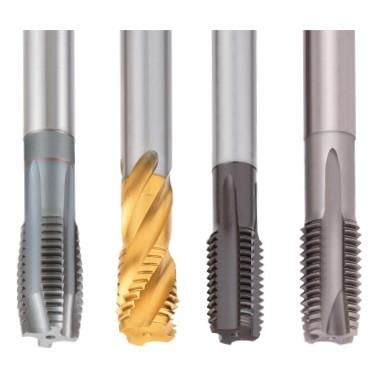
Select the type of tap We often use: straight groove taps, spiral groove taps, screw taps, extrusion taps, and their performance has their own advantages. Straight groove taps, which have the most versatility, can be processed through through holes or through holes, non-ferrous metals or ferrous metals, and are the cheapest. But the targeting is also better
Poor, anything can be done, nothing is done best. The cutting cone portion can have 2, 4, and 6 teeth, a short cone for the through hole, and a long cone for the through hole.
As long as the bottom hole is deep enough, the cutting cone should be used as long as possible, so that the teeth sharing the cutting load are more and the service life is longer.
Spiral groove taps are more suitable for machining non-through-hole threads, and chips are discharged backwards during processing. Due to the helix angle, the actual cutting front angle of the tap will follow
The helix angle increases and increases. Experience tells us: the processing of ferrous metal, the spiral angle is chosen to be smaller, generally around 30 degrees, to ensure the spiral teeth
strength. For the processing of non-ferrous metals, the helix angle is chosen to be larger, and it can be cut at about 45 degrees.
Screw taps, the chips are discharged forward when the thread is machined. Its core size is relatively large in design, strong in strength, and can withstand large cutting forces. Processing
The effect of color metal, stainless steel and ferrous metal is very good, and the threaded tap of the through hole thread should be preferred.
Special tap There are some special taps, such as jumper taps. It removes one tooth at intervals, and the pressure and friction between the workpiece and the workpiece are small, and the internal thread of the thin-walled part is machined.
Will not cause deformation of thin-walled parts. Others include a chip tap with a chip hole in the middle and a large diameter internal thread of tens to hundreds of millimeters.
New internal thread cutter The most worth mentioning is: an internal thread cutter used in CNC machining centers, which integrates chamfering, drilling and threading, using machine tool screws.
Rotary interpolation, the front edge of the tool can be drilled and chamfered, and the teeth on the side can be threaded. A tool can process snails with the same pitch and different diameters.
hole. The use of the tool has been expanded, the number of tools has been reduced, and the number of tool changes in the machining center has been greatly reduced.
The extrusion tap is more suitable for processing non-ferrous metals. Unlike the above-mentioned cutting tap, the working principle is that the metal is extruded to deform and shape.
Threaded. The extruded internal thread metal fiber is continuous, tensile strength, high shear strength, and the surface roughness of the machine is also taught, but squeezed
The bottom hole of the taper taper is required to be high: too large, the amount of base metal is small, and the internal thread has a small diameter and the strength is insufficient. Too small, closed extruded metal has nowhere
Can go, causing the tap to break. The calculation formula is: bottom hole diameter = internal thread nominal diameter - 0.5 pitch.
WALLSON EGCON

Comments